
Castello Dentice di Frasso di Carovigno
- Published in Posti da Visitare
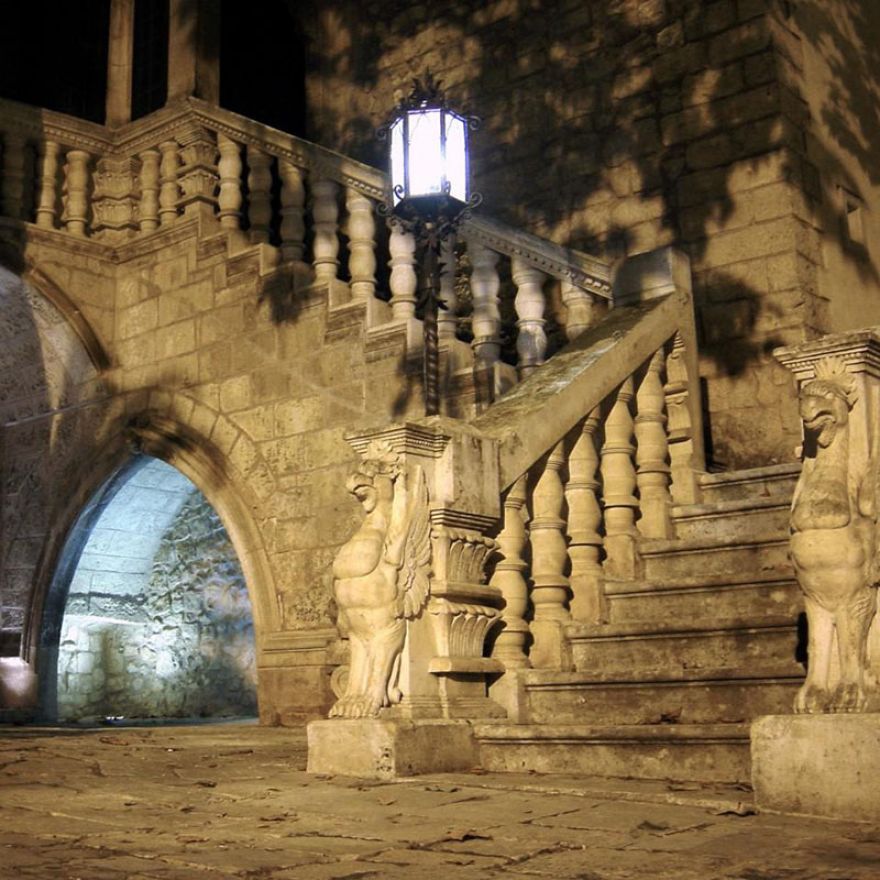
Il castello di Carovigno porta il nome della città su cui fu edificata l'antica Carbina. Come tutti i monumenti fortificati, sulla parte più alta del paese.
STORIA
Non si conoscono notizie certe sulle sue origini, ma secondo Vincenzo Andriani, il primo nucleo dell'attuale castello, nacque all'interno della cinta muraria durante il periodo Normanno.
Su una pergamena antica del 1163, conservata nell'archivio capitolare di Ostuni, si ritrova la denominazione di “Castellum Carvinei”, che consisteva in una sola torre della forma quadrata, posta sul lato di porta Ostuni. Tale torre fu costruita su una galleria sotterranea, adibita prima a prigione e poi a deposito olio. Successivamente con i lavori di restauro, venne affogata per motivi di stabilità e per maggiore precauzione, venne costruita una veranda arcata per puntellare la torre che minacciava di crollare da una parte, dall'altra parte fu addossata una torretta di minori dimensioni. Dalla veranda si poteva accedere alla Chiesa di Sant'Anna, percorrendo un camminamento ricavato sulla porta Ostuni, oggi ostruito. Sulle arcate della veranda, furono scolpite gli stemmi dei feudatari di Carovigno.
Il castello è stato ampliato nel tempo, secondo le esigenze dei principi feudali che l'hanno abitata. Oggi ha la forma triangolare (simbolo della perfezione) con la presenza di tre torri situate ai tre vertici: una quadrata, una rotonda e una a mandorla.
La torre a Mandorla, molto massiccia, con la punta rivolta verso il mare, detta anche torre a forma di carena di nave, fu costruita nel XV secolo dai Loffredo, principi di quel tempo. Lo scopo della costruzione della torre a mandorla, fu quello di schivare e deviare i colpi di arma da fuoco, lanciati contro di essa per limitare i danni.
Nel castello sono presente “le segrete” dei locali sotterranei, che nel tempo hanno avuto diverse funzioni, tra cui prigioni, depositi, cantine, laboratori di falegnameria.
STRUTTURA
Il castello ha una struttura a forma triangolare, con ai suoi vertici una torre quadrata, una circolare e una a forma di "mandorla". Nel resto della Puglia, ne esistono solo altri due di castelli simili, a Monte Sant'Angelo e a Rocchetta Sant'Antonio.
Il castello sorge a ridosso della vecchia cinta muraria a scopo difensivo per il paese. Dal castello è possibile ammirare un panorama che va da Torre Canne fino a Brindisi, ma abbracciando anche la Valle d'Itria, guardando anche altri borghi quali Ceglie Messapica ed Ostuni. Accanto al castello vi è anche la Chiesa di Sant'Anna, collegata attraverso Porta Ostuni, con un passaggio oggi chiuso.
LE SEGRETE
Nella parte inferiore più antica del castello, sono presenti dei sotterranei, detti anche segrete. Sono scavati nella dura roccia, confluendo in un corridoio principale lungo 17,90 metri, a 4,80 metri di profondità, largo 1,70 metri e alto 2,50 metri. Altre zone vennero chiuse per rendere più stabile la struttura soprastante. Si accedeva ad essi tramite una scala sita nell'atrio fino al 1920, ma anche tramite alcune botole oggi chiuse. Prima del restauro del 1904/1916, i sotterranei erano adibite a prigioni.
Ai lati del corridoio sono presenti delle piscine profonde 4 metri, rivestite da blocchi in pietra di Carovigno, tenute senza calce. Dopo il restauro queste zone vennero adibite a deposito dell'olio e a neviere.
The castle of Carovigno bears the name of the city on which the ancient Carbina was built. Like all fortified monuments, on the highest part of the country.
HISTORY
No definite information is known about its origins, but according to Vincenzo Andriani, the first nucleus of the current castle, was born within the walls during the Norman period.
On an ancient parchment of 1163, preserved in the chapter archive of Ostuni, we find the name of "Castellum Carvinei", which consisted of a single square tower, located on the side of Ostuni gate. This tower was built on an underground tunnel, used first as a prison and then as an oil depot. Later with the restoration work, it was drowned for reasons of stability and for greater precaution, an arched veranda was built to prop up the tower that threatened to collapse on one side, on the other side was placed against a smaller tower. From the veranda you could access the Church of Sant'Anna, along a path formed on the door Ostuni, now blocked. On the arches of the veranda, the coats of arms of the feudatories of Carovigno were carved.
The castle was enlarged over time, according to the requirements of the feudal princes who inhabited it. Today it has a triangular shape (symbol of perfection) with the presence of three towers located at three vertices: a square, a round and an almond.
The tower at Mandorla, very massive, with the tip facing the sea, also called a tower in the shape of a ship’s hull, was built in the fifteenth century by Loffredo, princes of that time. The purpose of the construction of the almond tower was to dodge and deflect gunshots, thrown against it to limit damage.
In the castle there are "the dungeons" of the underground rooms, which over time have had several functions, including prisons, warehouses, cellars, carpentry workshops.
STRUCTURE
The castle has a triangular structure, with a square tower, a circular tower and an "almond" shaped tower. In the rest of Puglia, there are only two other similar castles, Monte Sant'Angelo and Rocchetta Sant'Antonio.
The castle stands behind the old walls for defensive purposes for the village. From the castle you can admire a panorama that goes from Torre Canne to Brindisi, but also embracing the Itria Valley, also looking at other villages such as Ceglie Messapica and Ostuni. Next to the castle there is also the Church of Sant'Anna, connected through Porta Ostuni, with a passage now closed.
THE DUNGEON
In the lower part of the castle, there are underground, also called secret. They are carved into the hard rock, flowing into a main corridor 17.90 meters long, 4.80 meters deep, 1.70 meters wide and 2.50 meters high. Other areas were closed to stabilize the structure above. They were accessed by a staircase located in the atrium until 1920, but also by some trapdoors now closed. Before the restoration in 1904/1916, the dungeons were used as prisons.
At the sides of the corridor there are pools 4 meters deep, covered with blocks of Carovigno stone, kept without lime. After the restoration, these areas were used as an oil storage and snow storage.